
Netrokona farmers eye good yield of mustard cultivation

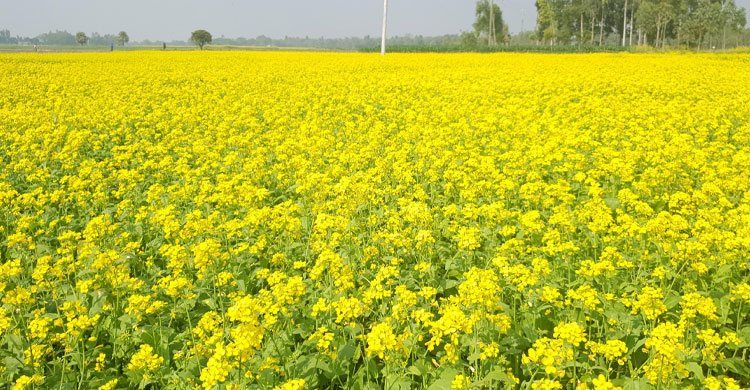
Mustard cultivation in the district has gained strong momentum this season, raising hopes for a higher yield as farmers make productive use of fallow land between Aman and Boro paddy cultivation.
With the arrival of winter at the end of Bangla month Hemanta and the beginning of Paush, vast stretches of farmland across the district have turned golden with blooming mustard flowers.
Encouraged by favorable weather, modern farming techniques and government support, farmers are increasingly cultivating mustard as an additional crop instead of leaving land idle.
According to the district Department of Agriculture Extension (DAE) office, mustard has been cultivated on 14,032 hectares of land in the district this year, surpassing last year’s target of 13,050 hectares. Officials expect overall production to be higher than in previous years.
Farmers said the cultivation of short-duration Aman paddy has created a window of two to two-and-a-half months before Boro cultivation, which is now being effectively utilized for mustard farming.
Abdul Mannaf Khan, a farmer from Paschim Uluati village in Sadar upazila, said he plans his cropping cycle carefully to take advantage of this opportunity. “After harvesting early Aman, the land remains unused for a long time. So I sow mustard seeds in mid-Kartik. It takes only three months to harvest,” he said. Last year, he produced five maunds of mustard from four kathas of land, inspiring him to expand cultivation this season.
Farmers said that although mustard cultivation involves costs for land preparation, seeds, fertilizers and harvesting, rising market demand has made the crop profitable. Currently, mustard is being sold directly to local traders at prices ranging from Taka 2,500 to Taka 3,500 per maund.
Many farmers also use the produce to meet their household needs by extracting oil for year-round consumption.
Rafiq Mia, a farmer from Light village under Challisha union of Sadar upazila, said mustard cultivation has long been part of local farming traditions, particularly on river char land. “If farmers cultivate mustard collectively again, the prosperity of earlier days can return,” he said.
Agricultural experts observed that crop diversity in upland areas has declined due to double-cropping of paddy. However, with proper planning, training and government support, farmers are now able to grow multiple crops on the same land each year.
Mukshedul Haque, Additional Deputy Director (Plant Protection) of the DAE, expressed optimism about the progress. “The period between Aman and Boro is a huge opportunity. We are encouraging farmers to cultivate mustard instead of leaving land fallow,” he told BSS.
He said that under government incentive programs, seeds and fertilizers have been distributed to 11,000 farmers, while another 3,500 farmers are receiving assistance through various agricultural projects.
Modern mustard varieties such as Bari Sarisha-14 and 17 and Bina Sarisha-9 and 11 are gaining popularity through yard meetings and field demonstrations.
“This silent revolution in mustard cultivation is now clearly visible, particularly in Sadar, Madan and Purbadhala upazilas,” he added.
With expanding acreage, strong market demand and continued institutional support, mustard cultivation in Netrakona is expected to contribute significantly to farmers’ incomes and regional agricultural sustainability.